Sunday, July 7, 2013

Saying goodbye

Sailors are always leaving. Even when they arrive, they’re half gone again. But it’s hard to depart from New York after five years: so many goodbyes, so many memories among those skyscrapers and rivers. A few regrets.

Our friend Emmanuel Dunand, an AFP photographer, caught us heading on the strong tide down the East River, toward the open sea. We look carefree, but there were tears an hour later as we passed under the Verrazano Bridge and out of New York Harbor. We had about 700 miles to go before reaching next land.


Leaving Manhattan -- photo by Emmanuel Dunand

Only an hour later racing under full sail into the Atlantic, “Moon River” struck something underwater with a shuddering bang. I looked back over the railing and behind us was a huge, semi-submerged log, perhaps part of a dock washed out during Hurricane Sandy and floating around ever since. It seemed almost as if land was trying to claw us back.

New York’s towers poked over the horizon all day, but by evening just a glow remained in the sky, and then only stars, thick and big and snowflakes. Keeping the first watch, I listened to National Public Radio's WNYC, that staple of my old New York life, a final time. I couldn't believe I was still able to pick up the station. Frank Sinatra was singing about the moon.

Then the FM signal on my little portable radio became so weak that if I tilted the antenna an inch the wrong way, I tripped into another station playing the heaviest of heavy metal. Then just white noise. We were alone in the Atlantic.

Goodbye Manhattan


To get from New York to the Sargasso Sea, you have to cross the Gulf Stream. Zephyr and Looli asked if we could go around. We couldn't. Nature had taken charge. We were no longer Manhattanites now. So we went through two days of squalls, waves smashing into the cabin, and the intended course that had been penciled so neatly across the chart going haywire. Call it price of entry to a wonderworld. 

Zephyr and Looli got through this lying in their bunks, clutching tiny buckets. Adele, sleepless even before we’d left New York, entered an advanced version of that zombie state common to first days on the high sea, every movement reduced to the minimum, just clinging on. I spent my hours outside with the compass and binoculars, water pouring off my ugly but impenetrable French fisherman’s gear, a kitchen timer next to my head to wake me every 15 minutes for a check of the horizon.

Then quite suddenly, the black-blue Atlantic turned Mediterranean blue. We penetrated the western edge of the Sargasso Sea. At last, the waves became regular and we started to see the windrows of sargassum weed that float across thousands of miles of the ocean, the so-called rainforest of the sea.

A small shark, or what we decided had the grey-torpedo look of a shark, followed us for hours. Dolphins leapt, at one point in such numbers that we had to stop counting – the sea boiling with their pearly dorsal fins. When I went down into the cabin, I could clearly hear their clicking and whistling through the hull.

Looli sings to the dolphins after the Gulf Stream crossing


A few miles short of Bermuda, the wind died entirely -- a classic Sargasso moment. These were the Horse Latitudes where becalmed Spanish mariners had to jettison their warhorses into the sea. But we didn’t care. The sea had opened its doors and, without even realizing, we’d made ourselves at home. We drifted, listened to music, and marveled at the change in our expectations.

Now the harbor in Saint George, Bermuda, is full of sailing boats preparing to cross the Atlantic. Most head north in search of steady west winds that blow to the Azores. Soon we'll also go looking for that oceanic highway, but first we're going to leave everything, everyone behind, and head southeast deeper into the Sargasso, searching for clues to its secrets – and troubles.


Friday, May 31, 2013

The Sargasso -- world's most mysterious sea

People cross the Atlantic all the time, but usually they're hurrying to reach the other side. I'm curious about what's in the middle.

In a few weeks, I'll be sailing with my family from New York to the mysterious center of the North Atlantic -- the Sargasso Sea. In the picture you see our boat "Moon River" being launched at a boatyard in the Bronx, following a long winter of preparations for our 10,000 mile voyage.

So what's the Sargasso? Egg-shaped and covering about two million square miles of ocean, the Sargasso is the world's only named sea without a coast. It's warmer, clearer, bluer, saltier and calmer than the rest of the Atlantic and fenced in by some of the strongest currents on the planet. Think of it as the eye of an enormous whirlpool.

The idea of a shoreless sea goes against logic. I like that. There are no harbors, no people, no national frontiers or laws in the Sargasso. If you fly over you'd probably see nothing but the same black blue Atlantic, vast and seemingly frozen in waves. But the Sargasso is entirely visible once  you get down there in a boat, a sea hiding within an ocean.

Stretching across the calm surface are endless islands of a unique, rootless seaweed. On these strange rafts live teeming colonies of fish and crabs and monstrous creatures camouflaged to blend in with the weed. Scientists call this floating archipelago the rainforest of the ocean.

The Sargasso is difficult to pin down, but here is a map from the 19th century that largely chimes with contemporary estimates. I got it from the National Oceanic and Atmospheric Administration webpage about the Sargasso at http://www.gc.noaa.gov/gcil_mpa_sargasso_sea.html.


In lore, the Sargasso is a sinister place. Christopher Columbus first realized he was lost here. His frightened crew, crossing the Atlantic for the first time, thought the thick weed meant they were about to arrive at land. But they'd only arrived in in the Sargasso, a sort of false continent before the accidental discovery of a real continent.

For centuries after, navigators tried to steer clear. Becalmed and dying of thirst, Spanish sailors would jettison livestock into the Sargasso's crystalline water, giving the area the name Horse Latitudes. Fantasies about vessels becoming enmeshed in malevolent weed eventually morphed into the 20th century myth of the Bermuda Triangle, where planes and ships disappeared without reason.

Those made-up tales were not entirely off the mark. Because of the Sargasso's whirlpool action, this is where plastic and other junk thrown into the Atlantic eventually winds up, hidden from the outside world and trapped for eternity -- a symbol of nature's power and vulnerability. Now, for environmentalists, the ocean rainforest has earned a less happy name: the Atlantic Garbage Patch.

Together with my wife Adele and our daughters Zephyr and Looli I'm exchanging the Big Apple for the big blue. Our course will take us for a year around the Sargasso, stopping only at the islands ringing the edge: Bermuda, Azores, Madeira, Canaries, Cape Verde, the Caribbean and Bahamas. In today's hyper-connected world, we're off to see a part of the planet that is literally adrift, a land that time forgot, and so off the grid that its borders change every day.

We're going from this:


To this:

And this blog, Voyage to the Sargasso Sea, is where I'll let you know what we discover along the way: about the Sargasso, about the state of the planet -- and ourselves.

The crew, the ship

So who would decide to head for the world's only shoreless sea?


Well here's the youngest, Looli, (and a spiny friend).


And the sharp-eyed Zephyr.


Proper shipmates they are.


Then there's Adele, dauntless seafaring Frenchwoman who when not riding the waves is penning dispatches for Le Figaro newspaper.


And me, a reporter for AFP news wire in a lot of places far from the sea (Russia, the Caucasus), but lately in New York City, whose grand harbor and pale green Lady Liberty we'll leave astern when we set sail for the Sargasso.


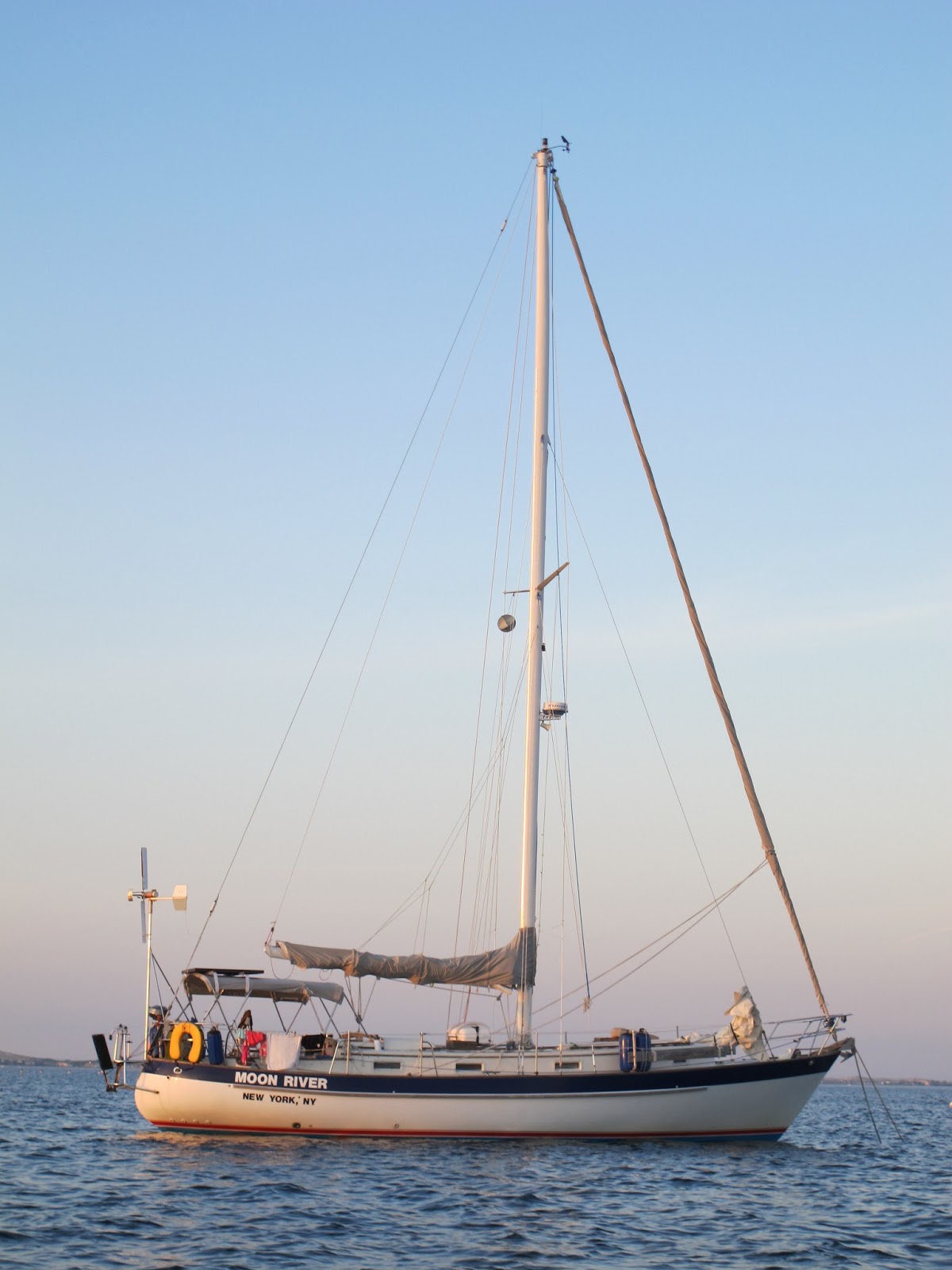
Lastly, let me introduce "Moon River." At sea, as in life, everything depends on your ship, and your ship depends on you. 


"Moon River" was designed by Bob Perry in Washington state and built by the venerable Valiant yard in Texas in 1988. We've rebuilt her from stem to stern over the last three years in preparation for this voyage. 

There used to be a lot of cool gadgets, like TV, air conditioning, a cabin heater, a machine that turned seawater into fresh water, and lots of other things. They're all gone. Things have got simpler.

We have enough water in two tanks for about a month of rations and two solar panels to keep electricity going, although once at sea we hardly use any. We have a dinghy with oars instead of a motor to get ashore; three decent anchors; an alarmingly large pump in case of flooding; a box of distress flares; numerous knives, tools, sail repair kits and fishing gear; and a deep bilge where we keep the booze -- in perfect dark, cool, cellar conditions.

All in all, "Moon River's" a simple, strong craft to take us into the wilderness. Learn to live simply and the really complicated things might open up.