Monday, February 3, 2014

Ghosts


I’m in English Harbor, Antigua, after our Atlantic crossing, and mindful of ghosts: under the palm trees, along the wooden balconies of colonial buildings, between the mangroves.

The tourist guides say English Harbor is the world’s only working naval port from the Georgian era, preserved as it was during Britain’s long conflict with France. And it’s true, the buildings where Horatio Nelson and thousands of his countrymen were stationed remain intact – even if put to rather different uses.

Where the great ships' sails were repaired, you now drink pricey rum; there's a beauty salon and wine bar in the cramped officers' quarters. What hasn't changed at all is that your anchor digs right into the same mud where tree sized anchors of the Royal Navy once dropped. Indeed, modern anchors not infrequently become entangled with remnants of chains and other artifacts from those days of maritime empire.

English Harbour looks quaint now, at times elegant, at times like a film set. Yet this port was originally built for war, a stern place and in the 18th century so ridden with malaria and other tropical diseases that sailors sent here from across the Atlantic died often without setting eyes on the enemy. But even cannons eventually become picturesque. Imagine the tourists crawling over an American base (Guantanamo or Okinawa might be the closest matches) in 200 years? The ghosts could already be gathering.


Tying “Moon River” to the old stone quay here was to tie also into history of my own that I had almost forgotten, or not forgotten, but put away, unloved, yet preserved all the same.

Sometimes it seems that we live several lives, moving on, reinventing, and yet at the same time never really outrunning ourselves. We shed much, but, voluntarily or not, carry bits of what happened, even if only a shadow -- perhaps the reason why we're rarely as much in control as we like to pretend. "I am a part of all that I have met," Tennyson wrote.

Certainly I've come to Antigua on my terms: as a father in my own boat, thousands of miles into a voyage construed from my own dreams, financed with my pennies, made with the woman I love, who is my fate, and with two children who are to us what rain is to the cloud. My world might appear well defined.

Yet another boat and very different me once moored at this same stone dock.


I was 16. I was on holiday from school in England and joining my father on his yacht, far bigger than “Moon River,” which he based in Antigua. I’d already been several times to the boat, either here or in other ports, each time showing up with my latest poor school reports, well-hidden cigarettes and ocean of teenage rage.

But this time, something was different. We had a guest on board: my sister.

Natasha and I hadn't seen each other since we were small children. We hadn't talked to each other, written to each other. We hadn't lived in the same country. Now, after a decade, in this Caribbean paradise, aboard this beautiful boat, we were being reunited.

Whatever extraordinary emotions, whatever tumbling of internal walls or awakening of dreams that may have occurred in those days, everything was filtered and obscured, as ever, through the deadening fog of my teenage mind.

I’d very much like to say, or at least think, that this meeting with Natasha was magical, or moving, or life-changing. You know, one of those Hollywood scenes with the swelling music.

Yet I didn’t feel this. Or didn’t want to. Or didn’t let myself.

What I felt more than anything was something like surprise: that this grown up girl – she had just turned 21 – really was my sister. The last time we'd been together she'd been about 11 and I about six (way back in another of those previous lives). So now she seemed unreal, yet real, already something like a particularly vivid ghost.

Uncertain what to do, I made sure I didn't appear to care. I suspect her approach was about the same. We simply existed in the moment. We went to a beach together. We walked about the shops. The crew on my dad’s beautiful boat took us snorkeling and so on.

For sure, we never talked about the past, never raised the subject. Most of that time in Antigua she was an abstraction to me, a person I might find on any boat in the Caribbean: that girl in the bikini, the girl in the hammock, the girl enjoying paradise. Not my lost sister.


Natasha was beautiful. She was tanned and smooth. A raging, boys-school teenager, I genuinely enjoyed the glamour of walking around with a girl – a real, proper girl. Really, that was probably the principal emotion I had, or let myself have: a self-congratulatory realization that my sister was beautiful.

I hardly remember anything we said to each other. We definitely never had that talk. I know that. But I also know there were moments when we caught each other’s eyes, Natasha and I, and that then we didn't speak because we couldn’t speak. Then we weren’t in paradise at all. We weren’t in one of those gaudy bars that the sailors went to; we weren’t on the dazzling beach; we weren’t on the sunbaked deck of our father’s beautiful boat. We were in some kind of abyss then, too far under to know which way was up, which down. Not an easy place, perhaps, but real and rare. I never realized how lucky I was.

Natasha’s visit to the Caribbean lasted a week or two, just like any ordinary holiday. It seems the reunion wasn’t a success. She flew back to our mother. I never saw her alive again.

Thirty years later, returning to English Harbour, I found myself looking for Natasha's ghost -- whether out of fear (a nervous look over my shoulder) or curiosity, I wasn't sure.

My quarry was elusive. Fact is, there’s literally only one place in English Harbour – an undistinguished stretch of road outside the gates – where I can remember precisely that I was with her.

Hard as I try, I can't even recall the spot where we'd said goodbye. She must have taken a taxi for the airport when she left. Had we gone with her? Did I kiss her on the cheek? Did we hug? Did we promise to write? Did we cry, smile, joke? Where exactly did I see her for the last time? I have absolutely no idea.


Frustrated, I searched for clues online (where else does the modern ghost hunter go?), discovering against all expectations that the professional skipper of my dad’s boat in those days is still around on the island. He’s become a painter. Plucking up courage, I went to see him, rowing "Moon River's" dinghy to the end of a mangrove-lined cove, and working my way to the road. Up the hot hill I walked. What would we even talk about? Would that summer with Natasha come up, or would it be just pleasantries? I found the place. But his neighbors told me he'd left, gone to England for several weeks -- far beyond the time I could spend waiting in Antigua. My heart pounded. What was the Greek god of anticlimax?

Despite all the heritage preservation, English Harbour has changed dramatically in the last three decades. Superyachts the likes of which were barely contemplated in the 1980s lie crammed into the old haven like rows of cars. Falmouth Harbour, once the down-at-heel extension of English Harbour, is even flashier. It was here that I now took my search.

On a hot, squally afternoon, I walked along the bay, uselessly trying to conjure the wilder 1980s, when I'd take out my rage on a windsurfer every day, tearing back and forth across the tropical water, hour after hour. Now superyachts swamp the landscape, enormous, opulent machines designed largely to make rich, old men happy. There's no room for a lonely kid on a board today.

But I remembered a rasta fisherman who used to operate from Falmouth back in the day. He'd had a shack by the roadside with a handpainted sign outside that said: "POWER, FISH, ICE."

My dad and I always loved that sign. The rasta was a big, fit man, impressive on his own terms. But the sign, crudely drawn, lent him an elemental quality in our eyes. On an island with an economy dedicated to doling out luxury and frivolity, the rasta (we decided) was a wilderness philosopher, a kind of tropical demi-god who mastered wild things in the sea, who combated the sun with ice, and in some Delphic way wielded power -- not just because he had a generator or stocks of car batteries in that shack.

Memory of the sign and its dreadlocked master became my totem now. The rasta was my link to the past. Not just to the past of Antigua, but to that other life of mine, and of my small family.

Still, the simple huts once lining Falmouth have been upgraded and yet again my search seemed doomed. Certainly I was never going to find that old sign. Back and forth I walked, remembering conversations with my dad, the crafty cigarettes I had in the bushes, the crackling Caribbean stars so different to what I knew in England, and the constant gnawing feeling of having been brought to a place where everything was perfect, but where what I really wanted would never be possible.

Suddenly between a small wooden house and a small food shop I recognized the spot. The shack was gone. The sign too. But the shape of the land, the rim of the road, maybe even the angle of the afternoon sun, merged, laser-like, so that I was sure immediately, beyond doubt. And on that spot stood a rasta – not young; about the right age in fact. He was washing a car.

The moment the rasta turned I knew he wasn’t the same man, but that did not matter. The past rushed in. "Power, fish, ice," I said. "Know what I mean? There was a sign with just those words on it. Another rasta, a fisherman... Big fellow..."

The passwords: Power. Fish. Ice.

The rasta began to mumble and it was only then I realized he had a speech defect and clearly other ailments, a man in suffering. Power. Fish. Ice. I kept repeating my question in slightly different forms until his answers stitched themselves together.

"Yes it was here," the rasta said. “That was my brother. He’s gone.”

“Gone where?”

“Gone, gone. Disappeared in the sea.”

I said I was sorry. The rasta put his hand out to shake.

"Peace."

"Peace."

Maybe I understood him, maybe not entirely. Can you ever understand ghosts?


About 15 years after Natasha came to see us in Antigua, I was at work in London when I got an email saying she had died. She drowned in the swimming pool at the end of my mother’s garden in South Africa.

I didn't know how to mourn for someone who had already vanished long before. I learned. Then I took the plane to my mother’s distant home for the funeral.

When it was time, I was the one who went to collect the ashes. The drive took me into a treeless, gritty Cape Town neighborhood far from the verdant garden (and fatal swimming pool) of my mother’s heavily guarded house. In a dim room, the undertaker gave me a box. To my horror – but also, I have to admit, my perverse interest – he hadn’t closed the lid properly and a light, yet distinct puff of my sister's ashes wafted up onto my hands: our first connection, you could say, in many years.

All my life the childhood ghost of Natasha had haunted me, the one from before we were separated, the ghost of my older sister in pigtails and riding clothes. Among the ashes, I met another, this wraith in a box.

And now that I am back in Antigua, typing this under a mango tree, I realize at last that I have found the third, a ghost to complete the puzzle, a ghost I can call up in the blackest tropical night -- the ghost of Natasha at 21, Natasha when she was right here with me, the numbskull, raging teenager. Natasha who vanished, who was reunited with me, vanished again, and now in some sense has returned.

I became angry (angrier!) in the wake of those unhappy holidays. Angry that I'd let everything precious slide from my hands. That I'd had no idea. Clueless. That I'd barely risen above that single thought: “Wow, she’s beautiful.”  No big chat, no rebuilding, or building, or any sort of construction whatsoever. Not even an exchange of mementos when we said farewell. Just rage and through the rage my banal, vain delight that this mysterious sibling was beautiful.

That anger's over now. Watching another rum punch sunset fade to nothing, watching ten and eight-year old Zephyr and Looli scamper around English Harbour, creating their own lives, I realize I can't change what happened 30 years ago. Besides, beating yourself up is, by definition, a battle you'll lose.

I've learned a lesson in coming back to Antigua. Learned that you can't argue with ghosts. You really can't. That you have to take them as they are. So I will.

Yes, let me say it.

Natasha: you were beautiful.


Wednesday, January 22, 2014

Into infinity


When we left New York last June, my goal was to explore the mysterious Sargasso Sea – the restless, yet strangely quiet heart of the Atlantic Ocean. And together with Adele, Zephyr and Looli I began in direct fashion, sailing to Bermuda, then far into this fabled zone of calms, floating weed, monstrous sea creatures and lost sailors.

But what on Earth have I been doing in Africa, you may ask. Well… And the Caribbean? I can explain… And what are those new charts for the coasts of Venezuela, Colombia, Panama and Mexico? Did I get lost in the Sargasso? Or did I lose the Sargasso myself?

Perhaps a little of both.

Or look at it this way.

There is no absolute agreement about where the Sargasso really is – and that’s part of the mystique. There are estimates and studies and there’s the general idea that the Sargasso is in mid-Atlantic, where you find floating sargassum weed.

Then again, you  may encounter rafts of sargassum in all sorts of places, patches taking their rootless freedom to extremes, nowhere near the center of the ocean. For example, we came across this bunch just a couple days off the coast of Gambia.

The green mat  in middle is an errant sargassum raft.... alongside an errant sailing boat


But you can also argue that the North Atlantic gyre, that phenomenon of winds and currents spinning clockwise about the ocean, amounts to a perfectly good border for the Sargasso. An invisible, landless border, yes; protean, always moving; yet undeniable.

The gyre could be said to start at the Gulf Stream, that submerged river roaring north past the United States. Then it bends right, sweeping past Europe, Africa, and back across to the Caribbean, then up into the Gulf Stream once more.

In one sense, this is a true barrier, because the Sargasso lies inside and cannot escape. Yet the gyre is also the motor creating the Sargasso in the first place, the whirligig with the still eye at its center.

So the scientists and savants can say what they like. I'm deciding I know where the Sargasso is. And that’s what we’ve been doing on our voyage: riding the Sargasso whirligig.

This December we found ourselves on the most fabled leg of the circle: the Trade Wind route between Africa and the Americas. Leaving Gambia and setting the bow of “Moon River” for Antigua, about 2,600 nautical miles (or 4,800 kilometers) to the west, we entered a part of the world unknown to mankind before Columbus.

Of course, the great Admiral found the Americas by accident. However, another discovery was his alone: that ships descending to a latitude of about 20 degrees north in winter will get hard, steady wind blowing in a gentle curve across the entire ocean. It’s a route as reliable and relentless as the turning of the planet, a watery autobahn that remade history.

In the early days of sail, even the clumsiest ship was assured a fast passage to the New World. Crews on today’s sailing boats, which are far more maneuverable, can set aside a lot of their fancy gear, rigging the sails much like those of the past. They need simply to point in the right direction.

There are occasional lulls. And we got a two-day gale near Cape Verde. But the overall sensation was of having only to grab the sky’s coattails and hang on, right up until the rocky entrance in English Harbour, Antigua , exactly 18 days later.


Roaring west, we slid down mesmerizing wave after mesmerizing wave, covering 140 nautical miles or so every day.

These are the latitudes of one-way trips and on leaving Gambia we were uncomfortably aware of seeing the same low African coast that bid farewell to those crowded slave ships streaming across to the Americas. Would the slave trade ever have grown to such grotesque proportions without that unstoppable conveyor belt of easterly winds? It seems unlikely.

Really, anything at all will complete the journey, given time. In 1982 solo sailor Steven Callahan sank near the Canaries and, unable to return upwind to relatively nearby land, kept going in his liferaft. For 76 days wind and current carried him drifting across the Atlantic -- to safety -- and all he had to do was stay alive. Which, amazingly, he did.

Along the way, his liferaft attracted first small creatures, then slightly bigger, and finally large, life-sustaining fish like dorados that Callahan speared, becoming king of a floating island that resembled nothing so much as one of those itinerant patches of sargassum.

“Moon River” seemed tiny in the great wilderness and we felt powerless before the forces of nature. Conversely we had harnessed that same power, becoming part of the great system - bit players in the theater of eternity. Not that people belong in the Atlantic gyre any more than they belong in space or deserts, but on a sailing ship, grasping the wind, we can pretend we do.

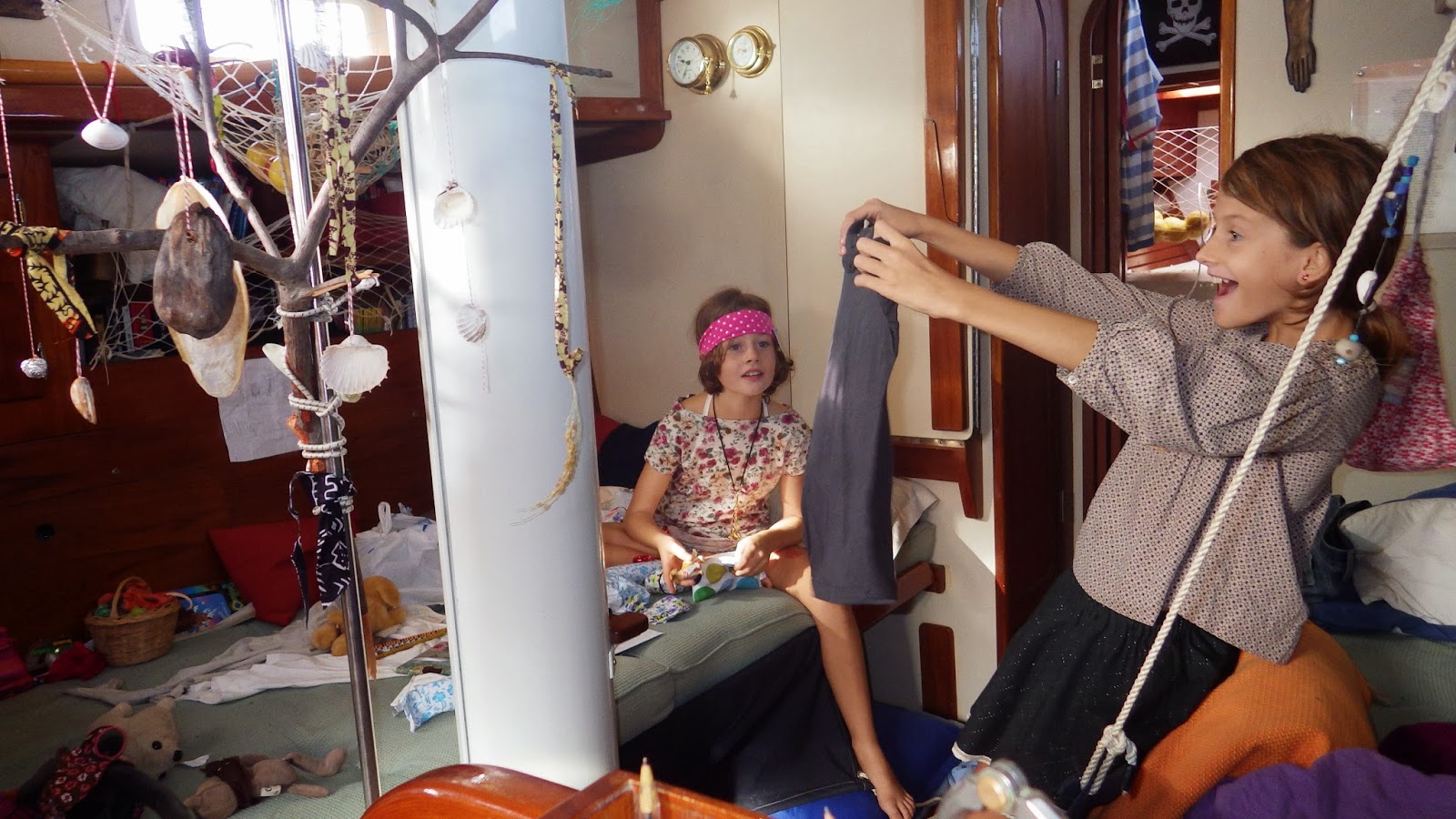
At Christmas, a thousand miles from land, we piled presents under a Gambian mangrove branch tied to the mast. We sang carols in the cockpit, the words blowing immediately away into the night. We marked the New Year under the stars, but the midnight countdown couldn’t have been more meaningless. Precise seconds count for nothing on a voyage like this – except when the navigator angles his sextant to capture the sun.

Anchoring in Antigua, we were overjoyed to see trees and people and tropical birds. Yet a piece of me remained out there in the eternal ocean and always will.

In those weeks, we were four shipmates bouncing around a cabin the size of some people’s walk-in closets. Yet the domed roof of the universe and the ocean miles deep under our keel were the true boundaries.

We were giants. And savage surroundings gave us peace.

Even in mid-ocean, the boat's turbulence will sometimes awake nighttime bioluminescence, these fireflies of the sea that defy the dark essence of their world. Each day, it seemed to me that Adele, Zephyr and Looli matched that miracle, lighting the ocean with courage – courage which we didn’t call courage, but laughter and love. HOLD FAST, sailors' tattooed knuckles used to read. Well, Adele, Zephyr and Looli - they held fast.

Opening presents on Christmas morning, 1,000 nautical miles and about a week from landfall

Even now the Trade Winds and currents roar outside the harbor in Antigua where “Moon River” is 
safely anchored. Finally, the gyre will bend around in the Caribbean to sweep north into the Gulf Stream, the Sargasso’s western border, and so start all over again.

We too.

From here we’ll head south, west and west again into the ferocious wind funnels of the Colombian coast, then north into US waters and the Gulf Stream once more.

We are nothing. Yet the sea is infinity – and in following the gyre we caught a glimpse.


Tuesday, January 21, 2014

Among the pirogues of Africa


Adele, Zephyr and Looli return from a Senegalese village

First came floating islands of sargassum weed. Next the rocky islands of the Atlantic. But finally in Senegal, then Gambia, the crew of “Moon River” stepped out onto a continent for the first time since we left New York last June.

By sailing to Africa from Cape Verde – with Halloween at sea – we added a strange protrusion from the otherwise circular path of our Sargasso circumnavigation.
Yet, continent or not, it seemed throughout our time in Africa that we were still barely more on land than afloat.

This wasn’t a trip to that Africa of savanna or mountains. There were no elephants or lions. This was a sojourn in the watery version of Africa, an Africa so impermanent, so vague, that land and water mix, literally, in a muddy expanse starting miles out to sea and narrowing into rivers that snake far beyond the coasts.


Few foreign sailors get to Senegal and The Gambia, and on arriving in a sailing yacht you can find yourself greeted as if you’d landed in a UFO. To most locals your boat not only represents unimaginable technical sophistication and wealth, but something even more incomprehensible: freedom.

"Moon River" in the Casamance River

African sailors of all stripes found “Moon River” a mystery, a sort of fragile toy, a luxurious caprice, and at the same time a machine for the kind of sea voyages they could not -- would not -- begin to contemplate. They were always amazed to hear we’d sailed from America, that we sometimes spent weeks on the open sea, and were preparing to sail on from Africa back across the Atlantic. At times they didn’t believe us.

In these waters, the only boat really at home is the pirogue. These come in different sizes but almost always the same banana shape. Some are the hollowed trunks of trees; others are constructed with planks. Some are left their natural wood color; others (most) are brightly painted and emblazoned with names like “Sante Yalla,” “Still Fire,” “Gamme Yalla,” “Koufa Yakour.” I saw one whose name was “In Jesus Name.”

Pirogues have paddles, not oars, which were considered a major technological advance in ancient times, but are not used in West Africa. Some have outboard engines.

And they all leak. In every pirogue someone is bailing water.

Pirogue fishermen occupy just about the poorest economic rung and one whom we met in Senegal’s Casamance River was so poor that even his bucket had holes. We gave him one of ours. We also gave him a little material to caulk the worst of his leaks.

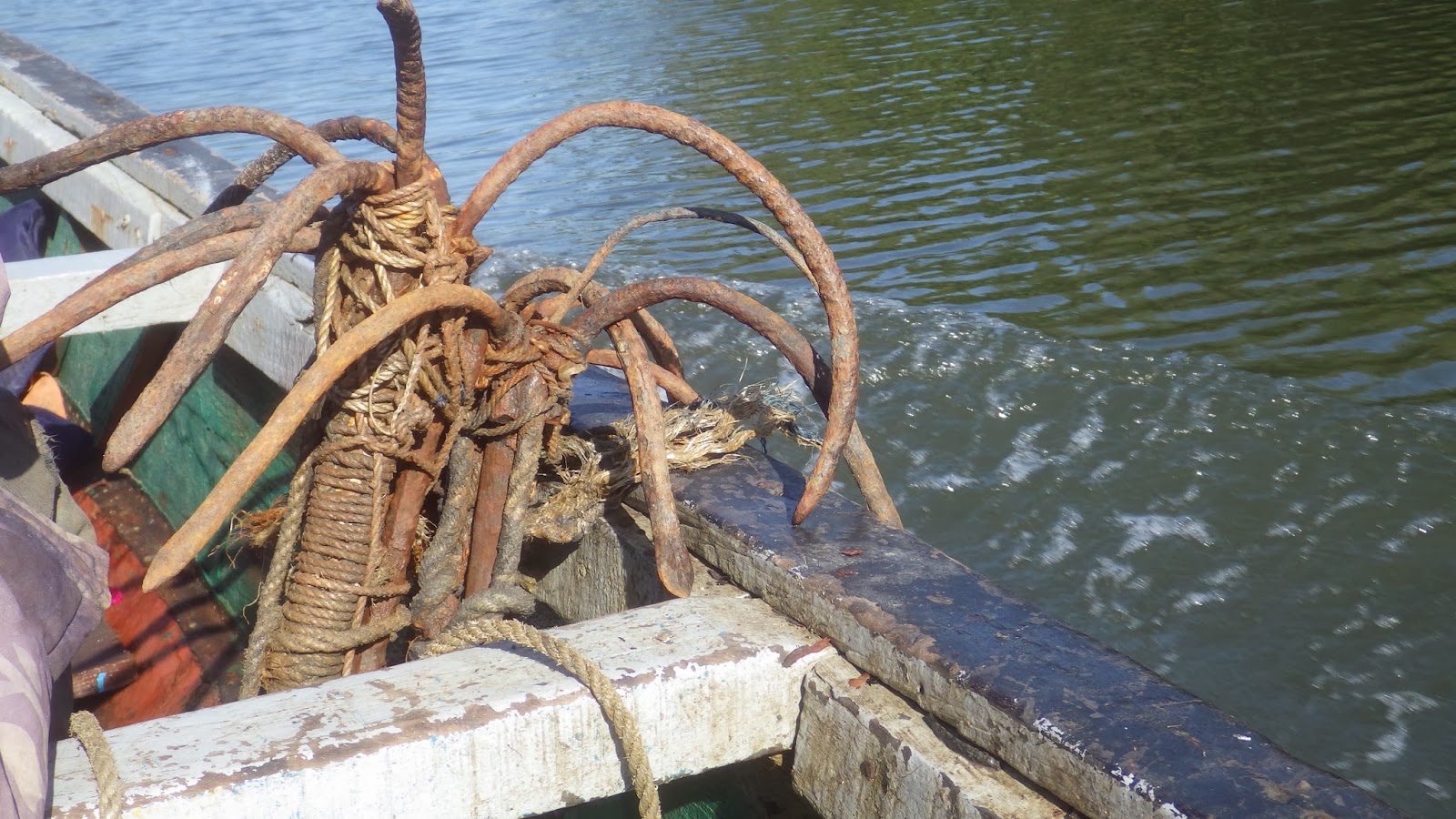
pirogue anchors

But the pirogue fishermen we saw everywhere – from the industrial harbor in Dakar to the furthest corner in the Casamance –didn’t let things like leaks get in their way.
Small pirogues with one or two men aboard sailed through creeks and rivers that don’t even appear on charts (not that they have charts.)

Senegalese fishermen Sherif and Zal


they caught a barracuda in a net

Big pirogues carrying crews of a dozen men and boys go 10 or 15 miles out into the Atlantic, where the seabed is still only a few meters down through murky water, and fish remain plentiful. At dawn, they return to their river harbors, roaring in, the crews in rags, but often strikingly proud looking, nonchalant, supremely comfortable aboard. They might as well have be coming directly from the set of a pirate film.


Hand building new pirogues in Dakar

Margins are thin and the risks enormous.

Once we gave a tow to two fishermen who had set themselves the task of paddling 14 miles upriver to market on a savagely hot afternoon. They had big fish in an icebox, but the ice was almost gone. I suppose if we hadn’t shown up, they simply would have kept paddling, and arrived with worthless fish.

Accident – good or bad – is the constant companion on these edges of the maritime world.

Some would call that fate, but the pirogue men do little to challenge their fate. They go with the flow, so to speak. They do things the way they’ve always been done. They keep bailing water. And paddling.

At night, sailing off the coast of Gambia, we found ourselves caught in a galaxy of pirogues, literally becoming trapped in the fleet and unable to turn one way or another without risking a new collision.

The pirogues hadn’t been out there as we sailed through dusk. So I don’t know how they all materialized miles offshore in the dark. But they did and then they were invisible, except for crazy assortments of lights waved in an effort to warn us away.

Normally, boats at night show internationally recognized combinations of colored lights. With these, you can signal your direction, your size, even the nature of your business. These codes are crucial to enabling boats to avoid each other.

But among the pirogues, the chaotic mixture of bicycle lights, torches, and sometimes even charcoal braziers, filled the ocean with incoherent flashes, beams, and flickers, forcing us to steer “Moon River” in zigzags, always trying to escape into clearer waters, but usually straying into yet another group of pirogues.


At best, a collision meant us becoming entangled in a net, ruining their fishing and perhaps crippling our steering gear. A direct hit could easily sink a pirogue and probably “Moon River,” and possibly kill a fisherman.

What could we do? What could they do?

big pirogue returns to Dakar at dawn
Those groups of pirogues kept popping up in the shallow seas right until dawn. Sometimes, one would motor right across our bow, showing no lights at all, and only the noise of the motor and phantom-like silhouettes of men in dug-out tree trunks betraying its presence.

Then incredibly, mysteriously, when the sun finally rose we found ourselves alone again. There was not a pirogue in sight.

We arrived in Banjul, the capital of The Gambia, as the sun rose red in a sky filled with Saharan sand. Now we were on the continent. Yet for me, we’d already been in deepest Africa.

We’d been there all night.

Going in circles


So I’m back. Or I never left, but my blog is back.
There’s some catching up to do. We’ve sailed “Moon River” to the Canaries, the Cape Verdes, Dakar, the Casamance River, The Gambia, and then across the Atlantic (again) to the Caribbean. And we’re about to follow the old pirate routes through the West Indies to Venezuela, Columbia, Panama and up past Mexico to Florida.
So where do I start?
And how?
But I will.
I haven’t forgotten – I just haven’t had the time, the full laptop battery, the Internet connection, or the soul power. Or not all at once.
I’m fixing that now though.
Watch this space.


Thursday, October 3, 2013

Wild nights

Non-sailing friends and even a few who’ve been on boats often ask, ‘What do you do at night – do you stop?’

The question isn’t so hard to understand. You imagine us rumbling across the ocean in our little shell, then seeing nothing. Besides, we need sleep just like any other human. Even the Cory’s Shearwaters, even restless sharks need to sleep.

But the answer of course is ‘No, we keep going.’ Wherever we are, 10 or 1,000 miles offshore, “Moon River” just keeps trundling along. We have a windvane self-steering mechanism which keeps the rudder straight and the sails are all tied off, so, really, there’s no need for us at all. The ship simply sails onward just as you set her to do back before the sun went down.

Early in our sailing days, Adele and I found nights daunting. On a moonless or, worse, moonless and cloudy night, the sky is so dark that sea and air combine and you can appear to be moving through a vacuum. There are brilliant, star-filled nights when the same sensation occurs: surrounded, almost inundated by stars, you again lose your sense of perspective and it can be hard to understand whether you are sailing level, down, or up right into the astral blizzard.

Tiredness plays terrible tricks, mind-bending and beautiful and cruel at the same time. In exhaustion, I’ve hallucinated that we’re about to sail over a cliff, or into a wall, or down what my addled brain is telling me is a gentle, endless slope of sea. But in this nocturnal hall of mirrors the sailor has to remember always one thing: the sea is flat. Not flat as in the world is flat, since of course the sea is curved; yet flat for practical purposes at least, because you will never fall off any cliff, much less run into a wall, or the stars.

So, basically, with experience you learn to catnap, to conserve your strength, and, above all, to trust your boat to carry you through the kaleidoscope.

Near shore, nighttime watch keeping means scanning the invisible horizon for lights of other boats – cargo ships chiefly and, if you’re on the continental shelf, fishing boats, which often sail erratically, chasing ever-declining quantities of fish, money and time.

Here, watchkeeping is a deadly game. You spot the lights and decipher which direction the ship is taking, how fast, at what angle, and on what business. The different lights tell you everything, once you’ve learnt the codes. A sailing boat also carries characteristic lights and, supposedly, the watchkeeper on the other ship will spot you, just as you spotted him.

But assume nothing at sea. In this game, falling asleep at the wrong time might mean never waking up.

Out of shipping lanes and in waters too deep for most fishermen, the rules change. Nights become magnificently empty. Sure, there’s always a chance of traffic, but most times you’ll be as alone as you can be on this Earth. You don’t even see planes overhead. You have an empty sky above, miles of unseen sea below, and many more miles of water parting ahead.

With the boat steering herself, you feel like a rider on a runaway horse. Or perhaps a prisoner. Or king.

In strong winds in the truly remote places I keep watch not so much for other boats or whales, but for “Moon River” herself. I don’t have to steer. I barely look at the compass – the windvane takes care of all that, keeping us on whatever course we’ve chosen. But I’m listening constantly to the rigging straining, the hull smashing into waves, and the cabin creaking below. Blind I may be, but my ears and body tell me when something unusual is occurring, even a change of wind.

On the good nights, I sit sheltered in the main hatch, my legs inside, my head and shoulders poking out, my perch giving me the sensation of having boarded a chariot. I marvel at the ridiculous wildness of the whole thing, at the stars raging and the wind sweeping us through the sea.


If I’m on watch, that means Adele, Zephyr and Looli are asleep below. Occasionally I’ll climb down into the cabin. The noise there is totally different – at once less and greater. The wind is quiet, but you hear the bulwarks complain and the sails and running rigging work against the mast. Every mechanical noise magnifies alarmingly through the deck.

Trying not to ruin my night vision, I prepare tea and noodles in the eerie blue light of the gas ring (a perk of staying up at night is a Hobbit-like rate of meals). In the dim, squint-inducing glow of the chart table lamp I update the logbook and chart. Then I check that Adele, Zephyr and Looli are snugly encased in their bunks. It’s always hard to believe the girls can sleep through the noise and motion, but they do, barricaded behind lee cloths with their stuffed animals (cat and rabbit for Zephyr; wolf for Looli).

Sometimes, especially when it’s rough, one of the children wakes as I pass. I’ll squeeze her hand in reassurance. Or it might be Adele who wakes, jumping up, asking if it’s already time for her watch. I put my finger to my lips and shake my head. My family's vulnerability -- and strength -- feeds a kind of savage determination in me.

Then squeaking in my boots and foul weather clothing, I climb on deck, and the wind and sea air blast me back into that other place as instantly as if in a spell.

Nights at sea can become otherworldly. You sail under the Milky Way as if it were an arch set up just for you and you watch the constellations slide, practically hissing as they enter the sea. The ocean, unseen, is at once alien and intimate and you know you don’t belong, yet managed to creep in anyway, trespassing in the house of God.

Strangely, it’s may be at night in these wild places that I find myself most connected to my own insignificant little world. The petty hassles of day are washed away – sleep deprivation and the elemental task of watchkeeping take care of that. No one in the world is left except Adele, Zephyr, Looli and the few who live always in my memory. Stripped down like this, there’s time to think, or not even to think, but simply to exist, entirely neutral, like an animal. I see life clearly.

Those moments are my ultimate luxury and usually I want nothing more than to live in them. But last month when we were on a passage between Madeira and the Canary Islands, I felt the unusual urge, quite suddenly, to connect with the world beyond, to share the moment, and perhaps to prove to myself that the other world still existed out there.

This was one of those starry nights, “Moon River” transporting me and my sleeping family through an astounding collision of water and stars. This was a night when nothing from my life could have any meaning at all and yet, for some reason, when that very same transitory, fragile, unimportant existence of mine, that messy patchwork of jobs, friends and loves, seemed suddenly precious. Three months after sailing out of New York harbor, I missed my land life. I wanted to know how my old colleagues at Agence France-Presse were doing, whether the Yankees would make the playoffs, how various love lifes were developing, and a dozen other less-than-galactic, but somehow vital questions.

Firing up the long distance radio, connected by a modem to my laptop, I sent an email to my Agence France-Presse partner in crime Mariano Rolando. I mailed his work address, an email carried improbably by HF waves up to the ionosphere, many miles above, then down to the Big Apple. Magically, Mariano replied back, almost instantly. He was covering a match at the US Tennis Open and was full of good old New York news, gossip, and sports scores.

The exchange – the experience of friendship across time and space – was as miraculous as the night outside.

And when I returned to my perch in Moon River’s main hatch I felt older and younger at the same time.

Somehow just like the stars above.


Nights can be long, but of course the sun also rises. This time off Madeira.


Who’s the savage then?

We humans are always patting ourselves on the back to celebrate our brilliant technological advances and understanding of the world. This voyage to the Sargasso Sea – well, and a few thousand miles around it – is partly to get away from all that.

It’s not always easy. Sailors can be some of the most materialistic people around. They’ll soon bore you to death with lectures on space-age kevlar sailcloth, carbon spars, GPS-radar overlays, and their beloved, electricity-guzzling “systems.”

Thanks to some of that technology, tens of thousands of people can now go to sea in a way that even a couple decades ago, before GPS and EPIRB distress beacons, might have been considered too daunting. Yet despite the gadgets (and partly because of them) there are few sailors – almost none – with even half the expertise, let alone daring, of a Francis Drake or Columbus, seamen whose boats wouldn’t even be legal in some countries today.

So that’s why a stop on “Moon River” at the Ilhas Selvagens, or Savage Islands, was so refreshing.

The Selvagens, ruled by Portugal, are a bunch of arid, barely habitable rocks scattered in the Atlantic between the much bigger islands of Madeira and the Canaries. If you want a high-tech taste of their remoteness, try looking them up on Google maps. You’ll do a lot of zooming.

Zephyr and Looli heading back down to the cove of Selvagem Grande -- with the island's one dog, "Selvagens."

Human life clings tenuously here. Failed attempts at colonization on the largest island, Selvagem Grande, echo in the sad little stone walls and crumbling livestock pens. The only place name here celebrating a supposed historical event – and this one is as unconfirmed as they come -- is Caverna do Capitao Kidd, a large, wet hole where the pirate may or may not have buried treasure.

Portugal keeps two wardens on the main island, occupying a tiny house built in the one decent anchorage, where “Moon River” lay peacefully between surrounding rocks and swirling surf.

Manuel Jose Jesus and his warden colleagues are the humblest of occupants, knowing full well that without outside help they wouldn’t last long. Everything, from water to beer and good Portuguese olives, is brought on the once-every-three-weeks naval ship. Even in dire medical emergency, it would still take a minimum four-hour roundtrip helicopter flight from a base on Porto Santo, an island near Madeira.

“It’s lonely,” Manuel said, although he was not complaining – the last time one of these warden jobs came up, 150 people applied.


Manuel


The house at Selvagem Grande
But the real kings of the archipelago are birds called Cory’s Shearwaters.

Almost 40,000 Shearwaters live on the Selvagens. They face few predators and so are fearless. When we arrived, we found their chicks, which resemble stuffed toys in their woolly down, sitting impassively in a vast collection of tiny hillside caves, while their parents wheel overhead, gathering noisily ahead of fishing trips.

Within a few weeks, those same chicks would finish shedding their juvenile feathers and, after being starved by their parents for a couple weeks, emerge from their caves. Lean and sleek, they’ll be ready – miraculously – for a few flying lessons and the start of a migration half way across the globe into the South Atlantic summer. Next February, some of them will do the whole thing in reverse.

Cory's Shearwater chick -- cute, but awesome 


Mariners have spent millennia perfecting ways to turn masts and canvas into airfoils, but nothing tops the Shearwaters’ long, thin, angular wings, which ride the wind like miniature America’s Cup boats, gliding more than they beat. Similarly, sailors have struggled forever with the need to carry enough drinking water. Shearwaters have an app for that too – special nostrils that desalinate ocean water, allowing them to travel free from land almost indefinitely. Of course their navigational ability, crossing trackless oceans right back to the very nests they were born in, is every bit as good as GPS.

Sailors would do well to stand back in awe of these marvelous travelers, but it hasn’t always been that way.

The Selvagens and their population of Cory’s Shearwaters came under protection of a natural reserve only in 1971, ending many years of human predation. Voyagers came to collect eggs to eat, others to strip the birds of feathers for sale. Selvagem Grande was even used for artillery target practice – you can still find chunks of shrapnel. Between the humans and the rats they probably introduced, there were eventually almost no Shearwaters left.

Today, Shearwaters have reclaimed their fortress in the Atlantic, while Manuel and his comrades resemble mere doormen to a great building – intimately knowledgeable, ready to serve, protective, and present, though not resident.

When the Shearwaters set out this month on their incredible journeys to the coasts of South America and South Africa, the island will fall silent. Manuel says that’s when he really feels the loneliness of his job. When they make the return journey, the pleasure is equal.

“Sometimes we’re annoyed with them because of the noise when we want to sleep and we can’t,” the soft-spoken former soldier said. “But when they’re not here, we feel strange.”

"Moon River," alone in the anchorage.
We were sorry to say goodbye to Manuel. He looked after us with all the enthusiasm of a man stuck on a deserted island. When “Moon River” left, he waved to us, standing on shore alongside his scientist friend Hanny and the island’s pet dog Selvagens.


But we didn’t really have to say goodbye to the Shearwaters: catching the wind south, we were heading even deeper into their home.


Monday, August 26, 2013

The (sea) emperor’s clothes

An apology. On starting this blog I vowed to myself I wouldn’t wander too far from the Sargasso path and into the minutia of daily life that plagues many sailing accounts – you know, the “today we changed the sails and our socks” school of blogging.

But forgive me if I make the occasional digression, starting today with the outwardly dull, but really very crucial issue of foul weather clothing aboard “Moon River.”

Yacht sailors spend enormous amounts of time outside, in all weather, often doing very little beyond staring at the sea. Being on watch is essentially a wetter version of sitting by the fire, a strange, sedentary existence in which your reveries are interrupted by rain, sea spray and the odd proper thumping from a solid wave.

There are two main options for attire.

The most common by far today, and espoused by my brave Adele, is to don breathable Gortex-type fabric used in spiffy looking suits made by Musto, Gill and the like. Outfits sold by these specialist manufacturers are waterproof, supposedly let your body breath, and look good, complete with lots of go-faster Velcro tabs and pockets designed to house every gadget on Earth.

Here is Adele, resplendent:


The other school is modeled by yours truly. This is the same get-up favored among French trawler crews and produced by a company with the unlikely sounding name of Guy Cotten. What they’re really made out of I’m not sure. My jacket is emblazoned with a prominent, enigmatic stamp reading: “no lead.”


My usual get-up. Bullet-proof, or at least waterproof.

I have a lighter orange top for warm weather. Jealous yet?


Now, it’s true that my garb brings to mind clowns, jesters and maybe sweet wrappers. It’s also true that when wrapped in what is essentially rubber you soon get that clammy, cold sensation familiar to anyone who has tried wearing rainboots without socks. And I can't deny that almost no one else on sailing yachts wears the things.

But you stay really, really dry.

Adele laughs at me in my Guy Cottens, even if they are French. Calais is also French, she reminds me. So are those little handbags Frenchmen carry. France can’t be perfect. Yet that’s no reason not to try and dress perfectly.

Such remarks wash off my Guy Cottens much as the Atlantic waves. I don’t laugh at her many-zippered, ergonomically refined finery. But I will register a few facts on the matter:

1. Guy Cottens cost about a fifth of their breathable brethren.

2. They won’t rip.

3. They not only keep you dry but can themselves be dried with the wipe of a towel. Gills and the like stop water getting in, but they themselves become wet on the outside and have to dry out. Not Guy Cotten man. He can come below after a good soaking and simply towel off as if emerging from a shower. The rubber is squeaky dry within half a minute.

I agree there are weaknesses in my get-up. The total lack of pockets (don’t French trawlermen ever listen to iPods, or at least keep their cigarettes somewhere?) is a pain. And in warmer temperatures the lack of air inside your suit can lead to noxious build-up of gases from within – both greenhouse and other.

But to me, no amount of convenience or glamor could top the bulletproof waterproofness of the things.

Now that I’ve already taken this blog down-market, I may as well go all the way with a final anecdote that I believe will persuade you to climb into your very own Guy Cottens. (Editor’s warning: from this point on, the blog may be unsuitable for some adults.)

So, what happened was that during an especially rough night watch in mid-Atlantic this July I found myself eager to pee. Very eager. Of course, even on the best night this involves disrobing, perhaps quickly, and that isn’t necessarily one of Guy Cotten’s strong points, given the absence of those high-tech quick release Velcro straps, convenient zips and all.

This wasn’t the best night. This was a near gale, with “Moon River” sailing beam on to bullying seas, constant spray and water swirling around the deck. Worse, heavy waves sent the boat reeling sideways every few seconds, so that even if I were to disrobe successfully, and avoid getting totally wet, the fraught stage of actually peeing – a bucket at point-blank range being the only feasible target – was alarmingly challenging.

Trying to hold onto the boat with one hand, undo my trawlerman’s duds with the other, and aim for the bucket, which was moving just as erratically as everything else, with the other, was impossible – since that would require three hands. Yet I did my best, grasping here, there, everywhere, and actually, heroically, managing to fulfill a good part of this mission.

Then – and this is all in the dark – came one of those really thumping waves. Over went “Moon River,” over went I, falling hard onto the other side of the cockpit. And, yes, over went the bucket, right over me.

At this point, knocked down and drenched in pee, a man wearing a lesser set of clothing might waver. Who would blame him?

But awash in that salty wasteland, my ridiculous rubber outfit made me a beacon of defiance. Laughing, I rearranged myself, pulled the jacket tight to my throat and stood, much like Odysseus before the mast, calling to the sea.

And the sea soon obliged.

Crash came the next wave. Seawater doused me, washing my Guy Cottens, the cockpit and unfortunate bucket all at once.

I was clean again outside, reborn. Inside, I was as dry as ever.

Clinging on to the boat that night, I even began to wonder if those bright colors didn’t actually look rather good.